
Understanding Medicare Advantage Plan Options
Compare Medicare Advantage plan types, prescription coverage, giveback benefits, OTC allowances, and special needs plans.

What is Medicare Advantage?
Medicare Advantage (Part C) is an alternative way to receive your Medicare Part A and Part B benefits through a Medicare-approved private insurer. Most plans include Part D prescription drug coverage. You generally must have Part A and Part B and live in the plan’s service area to enroll. You must continue paying your Part B premium, unless another program pays it for you.
The five official Medicare Advantage plan types
- Health Maintenance Organization (HMO): generally uses a provider network and may require a primary care doctor and referrals. Emergency care, urgent care, and out-of-area dialysis have exceptions.
- Preferred Provider Organization (PPO): offers network and out-of-network care, usually with higher costs outside the network. Specialist referrals generally are not required.
- Private Fee-for-Service (PFFS): sets what it pays providers and what you pay. Providers must agree to the plan’s payment terms; accepting Medicare alone does not mean a provider accepts your PFFS plan.
- Special Needs Plan (SNP): tailors coverage to qualifying groups. These include people with Medicare and Medicaid (D-SNP), certain severe or disabling chronic conditions (C-SNP), or qualifying institutional care needs (I-SNP). SNPs include prescription coverage.
- Medical Savings Account (MSA): combines a high-deductible health plan with a medical savings account funded by the plan. MSA plans do not include Part D; separate prescription coverage may be needed.
Understanding the five arrangements in the chart
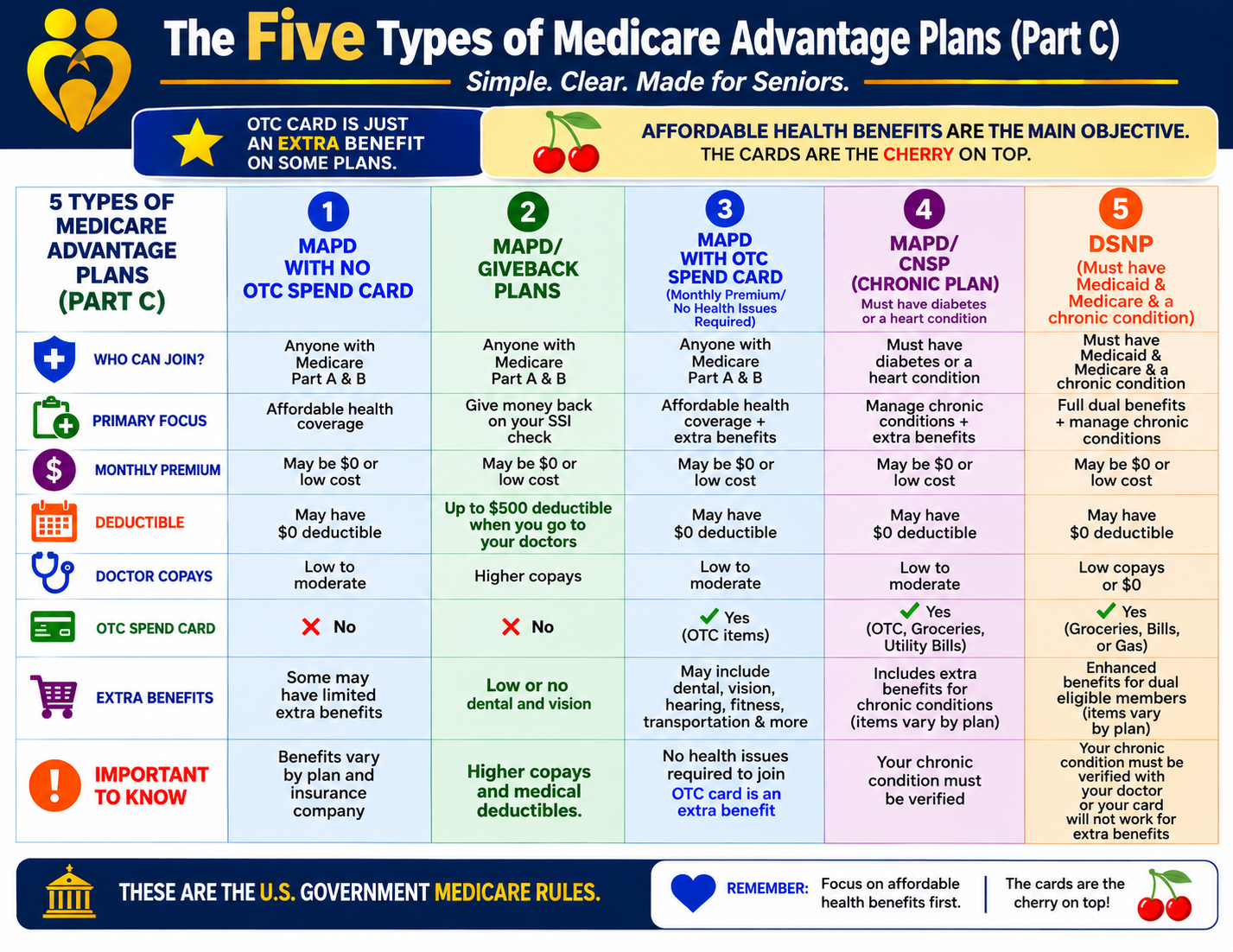
The chart below uses common benefit and eligibility groupings. MAPD means Medicare Advantage with prescription drug coverage. An MAPD plan may or may not offer an over-the-counter (OTC) allowance, and a giveback benefit may be offered by certain plans. These benefits do not define separate official plan types.
- MAPD without an OTC card: medical and prescription coverage without that particular allowance. Other additional benefits may still be available.
- Giveback plans: some plans pay part or all of your Part B premium. The reduction and how you receive it depend on your circumstances and the plan.
- MAPD with an OTC allowance: some plans help pay for approved nonprescription health items, subject to a spending limit and purchasing rules.
- C-SNP: designed for people with a qualifying chronic condition that the specific plan serves. Condition verification and plan availability matter.
- D-SNP: designed for people eligible for both Medicare and Medicaid. Medicaid eligibility levels and benefits differ; a chronic condition is not a universal enrollment requirement.
Look beyond the card
A food, utility, or OTC card should not be the only reason to choose a plan. Some additional benefits are restricted to qualifying members and cannot be used for every purchase. A $0 plan premium does not mean all care is free.
- Check that your doctors, hospitals, and pharmacies participate.
- Confirm your prescriptions, drug costs, and any prior authorization requirements.
- Compare premiums, medical and drug deductibles, copays, and the medical out-of-pocket maximum.
- Review benefit limits, eligibility requirements, and enrollment timing with a licensed agent.
Medicare Advantage benefit comparison chart
Important clarification: this supplied chart groups benefit arrangements, not the five official Medicare Advantage plan types. Its statement that all entries are U.S. government rules is not accurate. Benefits, premiums, deductibles, copays, and card eligibility vary by plan and location; the amounts and benefits shown are not guaranteed. A D-SNP requires qualifying Medicare and Medicaid eligibility, not necessarily a chronic condition. A C-SNP requires a qualifying condition specified by that plan—not just any heart condition. Giveback benefits reduce your Part B premium; they are not necessarily paid as cash. Review the plan’s Summary of Benefits and Evidence of Coverage before enrolling.
References: Medicare’s official plan comparison and Special Needs Plan eligibility.
Still have questions?
Book a free review with a licensed Regal agent — no cost, no obligation.
Book a Free Medicare Reviewor call 833-840-5683 (TTY: 711)
This article is for general educational purposes and is not a substitute for advice about your specific situation.